
Today I want to share my guide to visiting the Uros floating islands in Lake Titicaca, Peru with you. These human-made islands in Puno are unique, and they’re worth a visit for their cultural heritage as much as their aesthetic appeal.
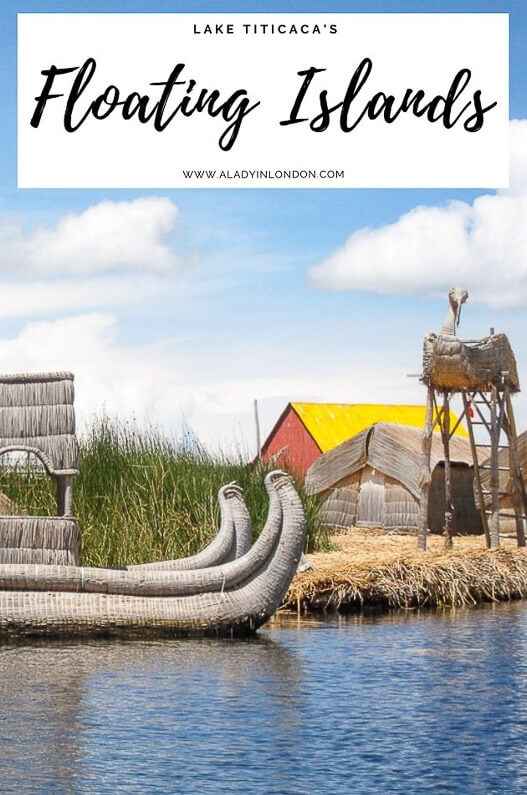
Floating Islands in Lake Titicaca
I wasn’t feeling well when I arrived in Puno. Food poisoning rendered me useless when I got off the plane in Juliaca, the nearest airport to the Peruvian city on Lake Titicaca.
But I was in Puno for one reason, and not even illness could stop me from seeing what I traveled all the way there to see: the fabled floating islands in Lake Titicaca.

Where to Stay near the Floating Islands
Woozy, I took a shuttle to my hotel, the GHL Hotel Lago Titicaca Puno. It was located on its own island just off the shore, and it had spectacular views of the lake.
As soon as I arrived, I asked the hotel reception staff if there was any way I could see the islands that day.
They quoted me a ridiculously steep US$75 for a private tour, but with an air sickness bag in one hand and my wallet in the other, I was ready to pay anything.

I had two hours to recover from my food poisoning before my tour of the floating islands in Lake Titicaca. I left the spacious hotel lobby, with its airy bar and restaurant, and immediately headed up to my room.
The GHL Hotel Lago Titicaca Puno had offered it to me on a complimentary basis for the night, and it had great wall-to-wall windows overlooking the lake.
I immediately fell asleep on the comfortable bed and slept until it was time to go. I woke up feeling about the same as before, so I grabbed another air sickness bag, went down to the lobby, and hoped for the best.

Floating Islands in Lake Titicaca Tour
My guide took me to our boat, which was conveniently moored right by the hotel. We climbed on board and sat outside for the 30-minute ride through the reeds.
Being out on the water made me feel a bit better, and the fresh air went a long way to keeping my illness at bay. I couldn’t wait to see the floating islands in Lake Titicaca.

The sun was shining and there was a nice breeze as we motored past small islands with foraging farm animals.
Apparently the locals drop them off in the morning and let them graze unsupervised all day because there’s no way for them to escape. Clever.

As we traveled deeper into Lake Titicaca, my guide told me that the floating islands—which are also called the Uros Islands after their inhabitants—are made from the reeds that grow in the water.
Their roots stick together and form a base on top of which the islanders place many more layers of reeds. The end result is a surface sturdy enough to build houses, restaurants, and even hotels on.

Pretty soon we reached the floating islands in Lake Titicaca and were able to see the miracle on the water for ourselves.
The archipelago consisted of a chain of small floating squares, each of which was connected to the one adjacent to it.

We alighted at one floating island and were greeted by two of its inhabitants. They gave me a demonstration of how the islands were built and let me climb an observation tower to see across to the neighboring reed platforms.
They also showed me the interior of their home, which was a simple one-room structure with a bed in one corner.

Nearby was a cut-out in the “land” where the islanders were farming fish. Close to that was a beautifully decorated boat that was used to ferry people between the floating islands and Puno.
Apparently the trip took two hours each way, and the children in secondary school had to make the journey there and back every day.

Back on our boat, we made a circuit around the rest of the Uros floating islands in Lake Titicaca. We passed several large ones housing elementary schools, hotels, restaurants, and other commercial buildings.
We drifted by smaller ones that held only homes and the boats that were moored to their sides. We even went by one that had a giant bird-shaped observation tower.

Regardless of size and ostentation, all the floating islands in Lake Titicaca were similar in that everything on them was built with reeds.
They were the same reeds we’d seen on the way to the Uros Islands and the same ones we saw on the way back to Puno.

When we arrived at the dock in the city, we could still see the floating islands in Lake Titicaca in the distance. They looked like small mirages on the water, and those images made them all the more mythical.

Uros Floating Islands in Lake Titicaca
It took several more days to overcome my food poisoning, but I couldn’t have been happier that I took my chances and visited the floating islands on Lake Titicaca.
I didn’t think anything in the country could top luxury travel in Machu Picchu and visiting the Amazon in Peru, but the miracles-in-reeds were as impressive as both.
The next stop on my South America trip was another island, this one in Bolivia. I looked forward to seeing if the Isla del Sol was as impressive as the isles I’d just seen in Peru. To be continued…
Want to see more? Take a look at my Peru travel video.
Find this post helpful? Buy me a coffee!
New here? Join thousands of others and subscribe to the A Lady in London blog via email.
Some of the links in this blog post are affiliate links. At no cost to you, I earn a small commission when you click on them and make a purchase. It doesn’t affect the way you shop, and it’s a great way to support the A Lady in London blog.
Pin it!
You poor thing! Have you read “Life of Pi”? There’s an island made of reeds in the middle of the ocean that reminds me of these Lake islands. Very cool..luckily unlike the book’s version they aren’t man-eating.
Hi Pam! Yeah, I have read Life of Pi! That’s true that the islands in the lake are very similar to the ones in the book! I’m glad they’re not man-eating, too!
I’m so sorry you were sick – and on Peruvian food, no less, which is usually so good! I’ve had several friends go to Lake Titicaca lately, so it’s very much on my radar, hopefully for the not too distant future.
Thanks Emily! You should definitely go if you get a chance. The area is really beautiful!