
Today I want to bring you my guide to a Beirut tour in Lebanon. Part self-guided, part guided, it has all the best things to do in Beirut. From sightseeing to waterfront strolls, it’s a great way to see the Lebanese capital.

Beirut Tour
After eating my way through the city during my 3 days in Beirut, I needed some exercise for both body and mind.
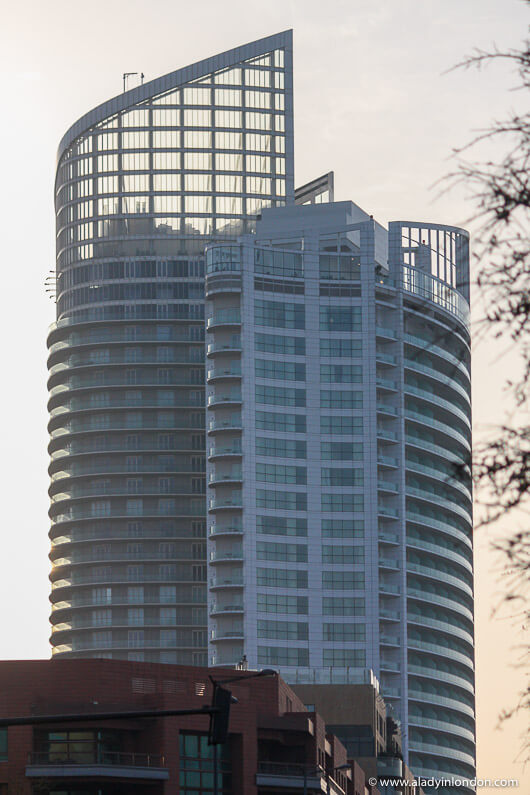
The Corniche
This started off with a walk along The Corniche, Beirut’s famous seaside promenade. The weather was beautiful on Sunday morning, and the whole city was out for a stroll.
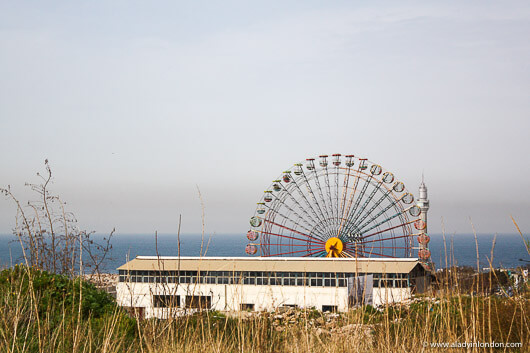
My Beirut tour went along the waterfront, past concrete beaches where people sunbathed and played games, alongside a carnival called Luna Park, and up a hill to one of the city’s most stunning natural landmarks, Pigeons’ Rock.
The beautiful rock arch rested just off the west coast of Beirut. Its striated form bore witness to its long history, making it seem much older than the modern city next to it.

But Beirut’s modernity belies its millennia of history. Most of what’s visible now dates from recent times, not least because of the civil unrest the city has seen in recent decades.
But dig a bit deeper and Beirut has its share of beautiful historic buildings and Roman ruins. You just have to know where to look for them.

Walk Beirut Tour
Or someone who knows where they are. In my case, this was Ronnie, a Beirut native who runs the excellent Walk Beirut tour.
After reading about the three-and-a-half-hour tour online, I emailed Ronnie to see if I could write about it in exchange for a ticket.
He said yes, and throughout Sunday afternoon I was captivated by his stories about the city’s architecture, people, politics, history, culture, and just about everything else.

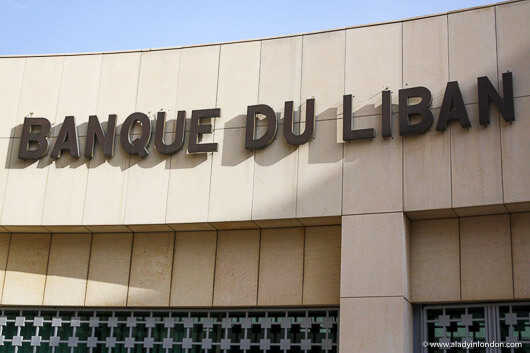
The Walk Beirut tour started at the Banque du Liban building, where we learned about the Lebanese currency (which is pegged to the US dollar) and religion.
Or rather, religions. There are officially 18 of them in Lebanon, and at our next stop we saw one of their churches: the Evangelical Protestant Armenian Church.
There we learned about Lebanon’s voting system and the fact that the Lebanese diaspora, which is spread across the globe from Los Angeles to Brazil, has to return every four years if its members want to cast their votes.
Nearby we saw several stunning examples of early 20th century Lebanese residential architecture in the Kantari Traditional Quarter.
The brightly-colored buildings combined design elements of Turkish, French, and local styles. The result was a unique mix of harem quarters, Art Nouveau ironwork, and triple windows behind ornate balconies.

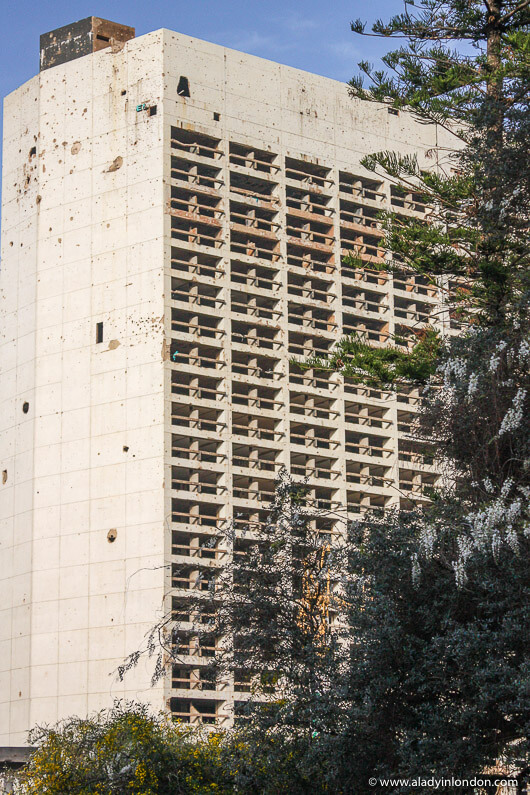
Down the hill from the houses was perhaps the most famous building in Beirut: the Holiday Inn. The hotel, which was only open for one year in the 1970s, was used as a base and lookout tower during the civil war.
It was looted in the beginning of the war, then fought over by every faction until the fighting ended in 1990. Now a shell of a building, it’s both a piece of living history and a haunting reminder of a painful time in Beirut’s past.
Not far from there was the Green Line, the section of the city center where the fighting took place during the civil war.
From the Green Line, the Walk Beirut tour continued as we walked through a pocket with new residential developments.
We learned it used to be the home of Beirut’s small Jewish population. There was a synagogue there that was slowly being restored.

After the war, a real estate development company called Solidere started rebuilding the area, offering shares to residents in return for permission to redevelop their land.
Much of the Beirut city center has been rebuilt by the company.
It sometimes replicates the former historic buildings that were in place before the war, and sometimes puts up new buildings. Locals have mixed feelings about its activities.

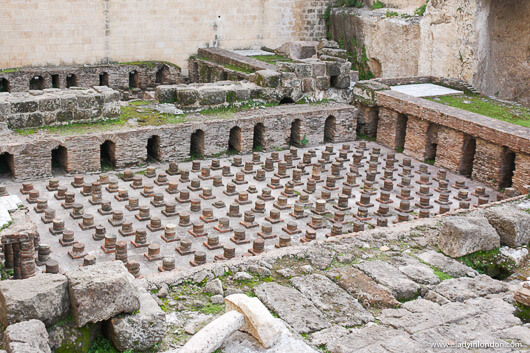
Continuing the Walk Beirut tour, we saw the impressive Roman Baths and the Place de l’Etoile, which features a tower from the French interwar period with a Rolex-sponsored clock in it.

The Walk Beirut tour then continued to Martyrs’ Square, a husk of its pre-civil war self.
As we learned about the square and the many protests that had taken place there, a side street filled with riot police and military troops.
Apparently there was a protest brewing that very night. We never saw any protesters and it didn’t appear to have made the news when I checked at my hotel the next morning.
Still, learning about the city’s history in the midst of it was particularly powerful.
The last stop on the Walk Beirut tour was a statue of a famous Lebanese journalist named Samir Kassir. He had written a famous book about the city, and had inspired Ronnie to start giving tours of Beirut.
Surrounding the statue were quotes in French and Arabic that have become famous in Lebanon.

As the Walk Beirut tour wrapped up, I felt like I’d gotten a better understanding of the city from someone who was incredibly passionate about his home.
I’d heard good things about the tour before I went, but it exceeded even my high expectations. It was one of the highlights of my trip to Beirut.
Beirut Tour
The next morning my hotel offered me a driver to take me on the quick 15-minute ride to the airport.
The city had been one of my top travel destinations of the year, and my short time there was enough to convince me to return.
If for no other reason, there are so many other amazing places to visit in Lebanon that I need to go back to cover more ground. And take another Beirut tour.
Find this post helpful? Buy me a coffee!
New here? Join thousands of others and subscribe to the A Lady in London blog via email.
Some of the links in this blog post are affiliate links. At no cost to you, I earn a small commission when you click on them and make a purchase. It doesn’t affect the way you shop, and it’s a great way to support the A Lady in London blog.
Pin it!
Quick question for a bit of fun – if you could only go back to one place where would it be?
Home excluded 🙂
Wow, that’s a really tough question, Mark! I think my answer would differ depending on my mood. If I were in a beach mood, I would say the Maldives. If I were hungry, I would say San Sebastian in Spain. If I wanted nature, I would say Chile. The list goes on…
Only just came across your blog – but it looks like a lot of fun. Some great photos 🙂 – Followed you on Twitter too
Thanks! Glad you like it!
Your part II description of your trip to Beirut is as enriching and full of details as part I.
All the best
Thanks Gabriel! I’m glad you enjoyed it!
Great illustration of how it is to travel there! Great historical architectures.
Thanks mcpalacio!
So glad to hear that you had a brilliant time in Beirut and that you loved Walk Beirut – the walking tour was certainly one of the highlights of my visit there.
Thanks Cara! The WalkBeirut tour was really amazing, wasn’t it?