
Today I want to bring you my expat’s guide to the Carling Cup final. This match at Wembley Stadium was my first experience at at a soccer game in London, and here’s what I discovered.

Carling Cup Final
Football is a religion in the UK. If there’s one thing I’ve learned since moving to London, it’s that every English person has a football team and their family has supported it since long before they were born. It’s tradition.
If your parents are Manchester United fans, so you will be. If they support Arsenal, there’s every chance you will, too.
It’s different with us foreigners, especially Americans. Not only do we not care much about football, we don’t even call it that.
Soccer is our preferred name for the game, and we tend to make snide comments about low scores and illimitable boredom whenever the subject comes up.
No matter that ninety percent of us played the sport as kids or that the same percentage of the rest of the world is obsessed with it. We still have no national soccer culture.
So what happens when an American moves to England and our worlds collide? Some expats choose to delve into their adopted culture, picking a team and buying a jersey.
Others choose to continue plowing ahead in their ignorance, hoping the sport will someday disappear from the national psyche of their new country.
Still others—and I fall into this category—lazily chastize themselves for not picking a team and getting into the local religion, but somehow never find time to do it.
That is, until yesterday. A Bermudian friend of mine with English ancestry grew up as most children of English parents do: a die-hard fan of his family’s team. In his case it was Manchester City.
When Man City—as it’s called in these parts—lost to Man U—as Manchester United is abbreviated—in the semi-finals of the Carling Cup, our friend was so disappointed he couldn’t stomach the idea of attending the final without his team on the field. He promptly offered the tickets to me and my boyfriend.
Having never attended a live professional football game before, my boyfriend and I figured it was about time we learned what this national obsession was all about.
But before we attended, I wanted to take a crash course in football jargon to prevent embarrassment at the event.
Accordingly, I spent the prior evening with some football-loving friends from whom I learned that while in America you attend a “soccer game”, in the UK you attend a “football match”. Yep, it was pretty basic stuff.
I also learned that Wayne Rooney, a Man U player I knew exclusively from the coverage of his wedding in the free newspapers on the tube, was one of the best UK footballers of all time.
Aston Villa, the team my friend instructed us to cheer for when bestowing his tickets upon us, had five good players. I couldn’t remember any of their names.
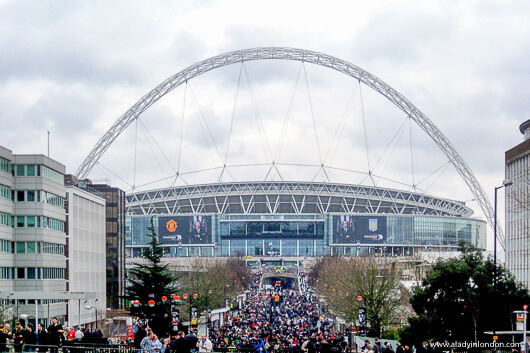
After the crash course in English football, my boyfriend and I headed to Wembley Stadium yesterday afternoon to watch the Carling Cup final.
The stadium was surprisingly close to our home in Hampstead (just one stop on the Metropolitan line from Finchley Road), which added to my creeping guilt over remaining agnostic to the religion of football in my years of living in London.
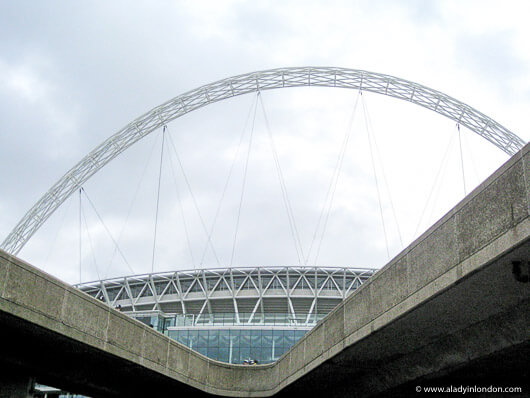
We stepped off the tube and faced Wembley Stadium. It was huge. As we stopped to take a few photos, streams of punters passed by us wearing football scarves and singing songs.
One song seemed to have the tune of “Go Tell it on the Mountain”, but the only discernible word was “Argentina”. I wasn’t sure how that fit.
The other involved the familiar lyrics “with a nick nack, paddy whack, give a dog a bone” but ended with a rather unfit-to-print directive for how the other team should go about returning home.
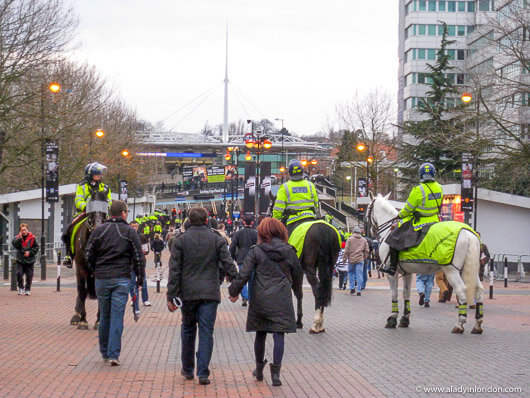
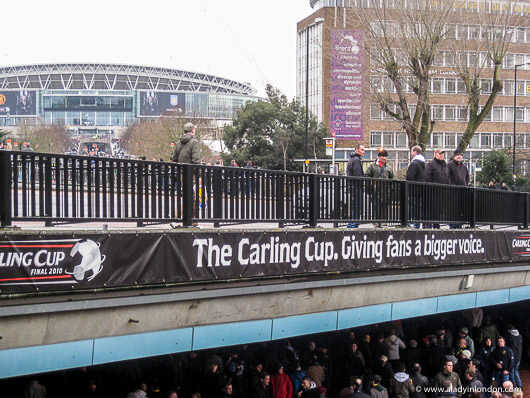
We continued our walk towards Wembley for the Carling Cup final, noting the yellow-jacketed riot police flanking the walkway and the sign that directed Man U fans to one side and Aston Villa fans to the other.
Not wanting to show too much of an allegiance to either side, went straight ahead to get to an entrance on the ground floor.

We entered Wembley Stadium via the Club Wembley doors. I scanned my ticket and waited for my boyfriend, who I assumed was having difficulties with the bar code scanner.
Unfortunately, the scanner had stopped him. Apparently the system thought his ticket had already been used.
Twenty minutes and lots of arguing later, we found out that the ticket dispatch had accidentally sent our friend a duplicate of someone else’s ticket instead of his own.
We finally got the situation cleared up and made it to our seats at the Carling Cup final—front row in the first level up—about ten seconds before kick-off.
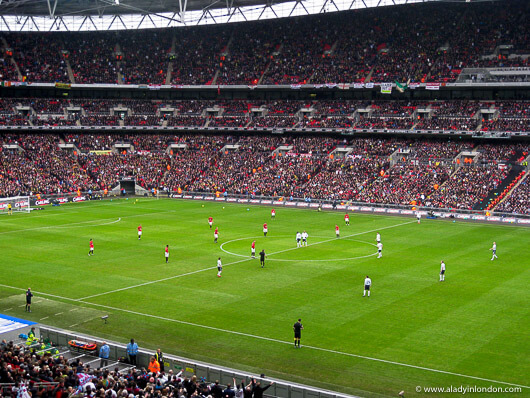
It took us a little while to figure out which team was which, as the fans seemed to be wearing totally different colors from the players.
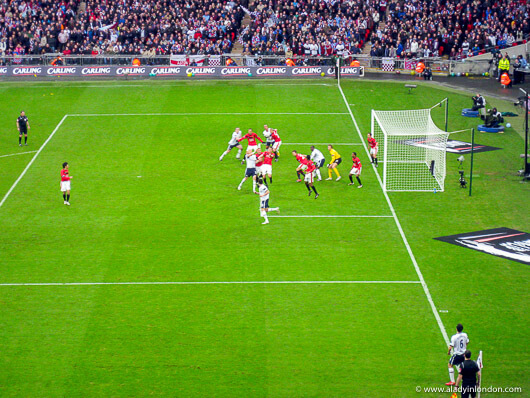
But once Aston Villa scored the first goal—a penalty kick in the first few minutes of the game—we were good on that front.
Then we realized the stadium was divided in half based on the fans of each team, so we could just cheer when everyone on our side cheered (not that we needed to follow their lead. Like many soccer-indifferent Americans, we both played the sport for years as kids).
After we figured out whom to cheer for, we settled in to watch the Carling Cup final. I have to admit that I really got into the game.
Don’t get me wrong. There was no Damascus Road experience of a giant soccer ball coming out of the sky to blind me into becoming a dedicated punter.
But by half-time the score was 1-1 and I was excited to cheer for Aston Villa during the next 45 minutes.
We spent the rather short half-time walking around the stadium, which wasn’t all that dissimilar from an American baseball stadium.
There were the concession stands, which in spite of selling meat pies as opposed to hot dogs, were similar to those in the States.
Then came the souvenir stands, where we could’ve purchased any number of football-related articles of clothing, not unlike in the USA.
There were also the restrooms, where I was delighted to discover the women’s with no line and the men’s with a line a mile long. It felt like I was back at a Giants game with the male-female ratio way off the global norm.
The only major difference I noticed was that there was no alcohol allowed in the stands at the Carling Cup final. Presumably this was to keep brawls to a minimum, and I should have supported that.
But the new convert in me really wanted to see one of the fights UK football is so famous for (and for which security was presumably so beefed up).
We returned to our seats for the second half of the match and cheered again for Aston Villa to win the Carling Cup final.
Sadly, our wish didn’t come true. Man U scored another goal late in the second half, and Aston Villa never recovered.
At our friend’s insistence, we left the game five minutes early. He wanted us to avoid the massive crowds that caused him to spend three hours getting back to central London on his last trip to Wembley.
We felt a bit guilty about leaving the Carling Cup final early, something my boyfriend likened to his childhood habit of ditching Mass right after communion (although his adult guilt for that didn’t seem very sincere).
On our way back to the tube, we walked past an even more numerous group of security guards, bus loads full of riot police, and law enforcement officials on horseback.
Weaving our way through them, we arrived at the tube just in time to catch the Metropolitan line back to Finchley Road.
I returned home a bit sad for my friend’s sake that Aston Villa lost the game, but happy to have finally experienced a demonstration of the UK’s biggest religion.
The Carling Cup final was definitely a highlight of my cultural education in the UK.
Now that I know how close Wembley stadium is to my home, I might just make the full commitment and convert to Footbalism. My team loyalties are up for grabs right now, so make your bids early.
Find this post helpful? Buy me a coffee!
New here? Join thousands of others and subscribe to the A Lady in London blog via email.
As an American there is certainly no harm in supporting the Villans as they have an American owner, but most Americans I know support Fulham. A season or two ago they had more American players than any other Premier League club, and there's still a couple left, notably Clint Dempsey. Last season my best mates and I, each of whom support completely different clubs, bought a season ticket at Fulham. As you rightly pointed out, football is a religion in these parts and we were dying to watch Premier League action for the cheapest price in London. Fulham's season ticket is more than 3-times cheaper than Arsenal's (£300 v £1000) and the cheapest in the entire country; despite being located in London! Even if a season ticket seems too heavy an investment, I'd definitely recommend going to a game at Fulham. Every game I've been to there's been a healthy dose of American accents filling up the air on the way to the ground.
Oh and as for the lack of alcohol. There's a law called: The Sporting Events (Control of Alcohol etc) Act 1985, which "makes an offence of trying to enter a ground when drunk or in possession of alcohol; of possessing or consuming alcohol within view of the pitch during the period of the match; or being drunk during the period of the match". Though between you and me, there's a way to catch a glimpse of the action at Fulham's Hammersmith End while chugging down your bottle.
For real ale drinkers who are also sports fans, cricket is where the action's at! It's not the kindest of sports to those who didn't grow up with it, but when the beer rolling during a game of five days, boredom is just about the last thing entering anybody's mind!
This is turning out to be a very cool blog!
Thanks! I'll have to check out Fulham sometime!