
Today I want to share my guide to the Lord Mayor’s Show in London with you. This centuries-old annual tradition is a great way to get into the City of London spirit.
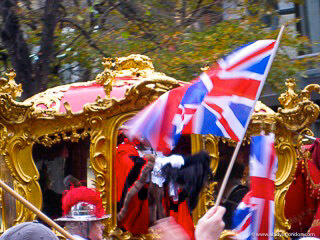
Lord Mayor’s Show in London
One of my favorite expat expressions goes something like this: “the English think 100 miles is a long way, and the Americans think 100 years is a long time”.
Given I come from a state that’s less than 200 years old, living in London has me in perpetual wonder—and near constant confusion—over the city’s long history and traditions.
One such tradition is the Lord Mayor’s Show in London, which welcomes the newly-elected mayor of the City of London each year. Dating back centuries, it’s the world’s oldest civic procession.
The show takes place annually on the second Saturday in November. It travels along a three-mile parade route through the historic streets from Mansion House to the Royal Courts of Justice.
Upon arrival at the courts, the Lord Mayor (who, confusingly, is different from the actual mayor) takes an oath of allegiance to the monarch in the presence of the Lord Chief Justice and the judges of the King’s Bench Division.
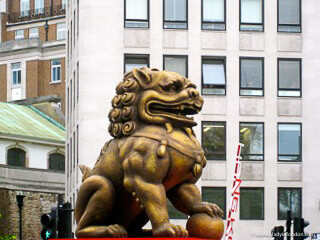
Basically, the Lord Mayor’s Show in London is a grand old tradition that’s now a great excuse for fancy dress and some fireworks.

This year the Lord Mayor’s Show took place on Saturday morning. Having never been before, I went with an expat friend to watch the parade near St. Paul’s Cathedral.
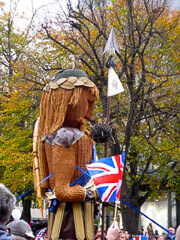
As a foreigner, the first thing I noticed about the the Lord Mayor’s Show in London was that it had quite an eclectic blend of floats. First came a toy-covered float sponsored by a large children’s store in London.
This was closely followed by several military tanks and various bands.
Charity floats came next, and after them a hodgepodge of floats with all kinds of people, from heavy metal youth bands to Notting Hill Carnivalesque performers representing a medical college.
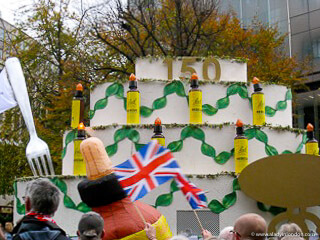
The most confusing part of the Lord Mayor’s Show parade came at the end, though. There were several carriages carrying official-looking people dressed in bright red robes.
Despite the pomp of their attire, they were all holding hand puppets. Smiling like children, they—or rather, their bears, toucans, dogs, and other assorted furry friends—waved to the crowds as they passed by.
My friend and I smiled along with them, a bit bewildered by it all.
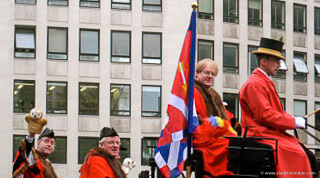
At the end of the hour-and-a-half parade, a beautiful red-and-gold carriage went by. Inside was the Lord Mayor, who doffed his three-cornered hat as he rolled past.
After the Lord Mayor’s Show in London receded into the distance, my friend and I went to have tea to warm up.
As we discussed the procession and its traditions, I realized 100 years may not be such a long time after all. However, 800 years is long enough to develop customs that confuse all but the locals!
Find this post helpful? Buy me a coffee!
New here? Join thousands of others and subscribe to the A Lady in London blog via email.
Thank you so much for sharing all of your wonderful English experiences! I too am intrigued (and somewhat baffled) by some of the English traditions. I’m actually heading to London next week for some fun and pub time. Any interesting events you’re aware of going on next week?
Thanks Tiffany! Not sure about specific events for next week, but you could check out Time Out.
Well, as an ex-pat Montrealer living in London nothing surprised me more than St George’s day. I woke up one morning in late April and small children were charging at me with their swords. At first I thought it might be a celebration of medieval anti-immigration policy but wikipedia was kind enough to shed light on my confusion. To be honest, I loved every second of it. To see a culture celebrating a hero that died around 300 AD, actually, 303AD to be exact, tells me how old this culture really is…they actually remember the exact date of a hero’s death. Great post. Believe it or not I actually regret missing Lord Mayor’s show. For all its confusion, English culture is actually fun to dive into…especially the food and pubs!